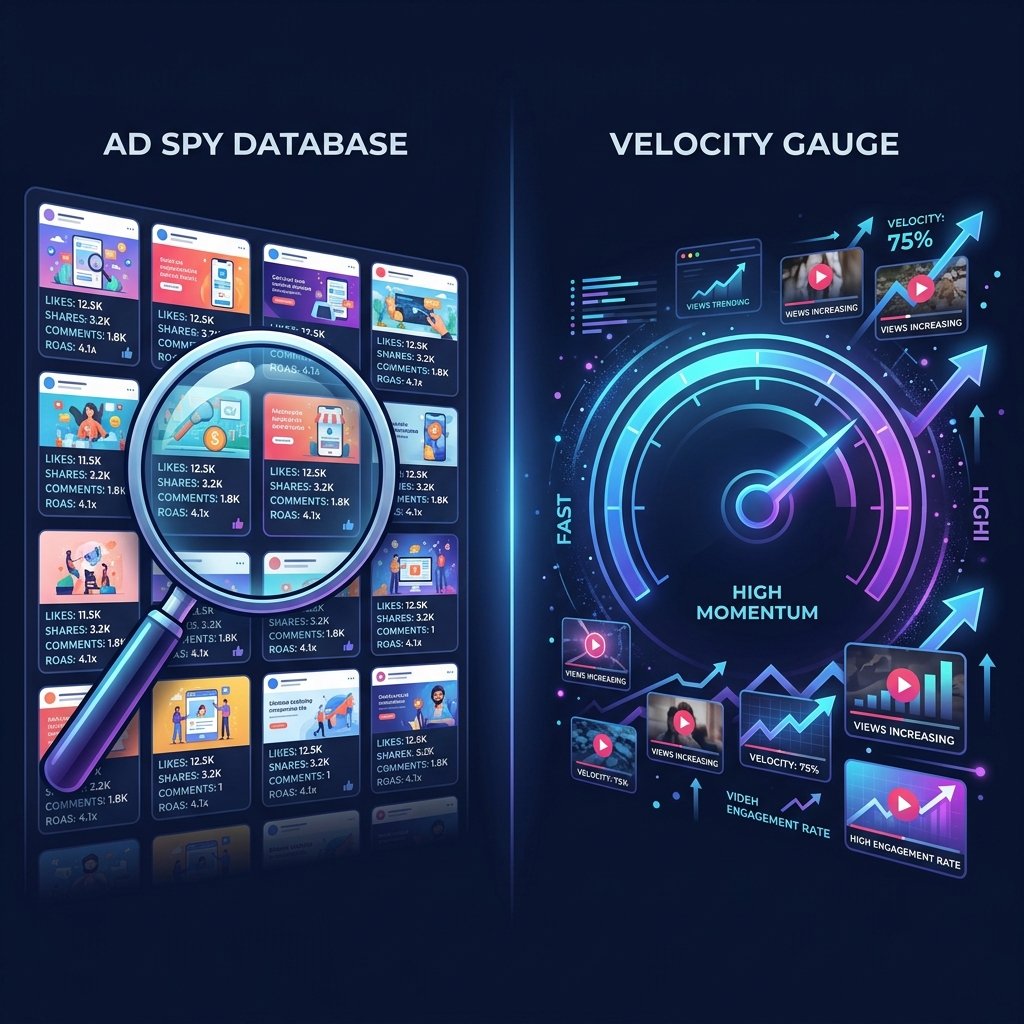
This is the second article in our honest comparison series. The first covered PiPiADS vs VelocitySpy — if you are also evaluating PiPiADS, start there. This one is about Minea, which is a fundamentally different tool from PiPiADS and therefore a fundamentally different comparison.
Let me be straightforward about what we are comparing. Minea and VelocitySpy are not competitors in the traditional sense. They do not do the same thing. Calling them alternatives is like calling a weather forecast and a surfboard “alternatives” — one tells you the conditions, the other helps you ride the wave. Both are useful. Neither replaces the other.
But if you are deciding where to spend your monthly tool budget, you need to understand what each tool actually does, where each one genuinely excels, and which one matters more at your current stage. I am going to be honest about both — including where VelocitySpy falls short.
What Minea Actually Does
Minea is an ad intelligence platform. It scrapes paid advertisements across Facebook, TikTok, and Pinterest — over 900 million ads in its database — and lets you search, filter, and analyze them.
Its core strengths are clear and well-earned.
Multi-platform ad coverage. While most ad spy tools focus on one platform, Minea covers three major advertising networks from one dashboard. If you run ads across Facebook and TikTok simultaneously and want to study competitor creatives on both platforms without switching tools, Minea is genuinely excellent at this. The breadth of coverage is its primary competitive advantage over single-platform spy tools.
Creative analysis depth. Minea’s real value is not just finding products — it is studying how products are advertised. Which hooks stop the scroll? Which ad formats drive clicks? What landing pages are competitors using? Which calls-to-action convert? This is intelligence that directly improves your own ad creative, and it is the reason media buyers love the platform. If you spend money on paid advertising, studying what works for others before spending your own budget is a rational investment.
Shopify store intelligence. The Premium and Business plans include tools to analyze Shopify stores — estimated revenue, best-selling products, traffic sources, and conversion metrics. This is useful for validating whether a product you have found is actually generating sales for existing sellers, rather than just being advertised without results.
Influencer tracking. Minea can track influencer placements, showing which products are being promoted through sponsored content across platforms. This is a data point that most other tools do not offer, and it is particularly useful for sellers who want to run influencer campaigns and need to understand the competitive landscape.
Where Minea falls short
I would not be writing an honest comparison if I did not address limitations. These are not bugs — they are inherent to Minea’s design philosophy.
Every product in its database is already being advertised. This is not a flaw; it is a feature of how ad spy tools work. Minea is built for people who want to see what is working in the paid ads ecosystem. But by definition, every product surfaced by Minea is past the organic discovery phase. Someone already found it, validated it, and started spending money to sell it. You are seeing the proof of a market — and so is every other Minea user running the same filters.
Credit-based pricing. Minea uses a credit system where every search, filter, and detail view consumes credits. Heavy researchers can burn through the Starter plan’s 10,000 credits quickly during intense research sessions, especially when exploring multiple niches. This creates a secondary decision at every step: “Is this particular search worth spending credits on?” which adds friction to exploratory research.
No real-time momentum data. Minea can tell you that a product has active ads. It can show you when those ads started running. But it cannot tell you whether consumer demand for that product is accelerating or declining right now. It is a snapshot of advertising activity, not a measurement of consumer interest trajectory. This distinction matters because a product with 20 active ads could be in its explosive growth phase or its decline — Minea shows both situations identically.
What VelocitySpy Actually Does
I will be equally straightforward about what we do and what we do not do.
VelocitySpy tracks organic TikTok e-commerce videos — not paid ads — and measures how fast they are gaining views per hour. That measurement is what we call velocity. When multiple independent creators post videos about the same product and all of them show rising velocity, that is a demand signal that exists before anyone starts advertising the product.
Early product detection. We catch products in the first days of their trend cycle, during the organic viral phase when creators are posting about products because they genuinely found something interesting — not because they are paid to promote it. This is typically 3-7 days before the same product appears in ad spy tools like Minea or PiPiADS. That head start is the core value proposition.
Velocity trend tracking. Not just a single velocity number, but the direction — is velocity accelerating, stable, or declining? This trend direction is the single most important saturation signal in product research, and it is data that no ad spy tool can provide because ads do not have a concept of “momentum.” They are either running or they are not.
Multi-creator validation. We cluster videos by product and show how many independent creators are generating views for the same product. This separates genuine consumer demand from one-off viral videos. One creator going viral proves nothing about a product. Five independent creators gaining traction proves the product itself is interesting.
Where VelocitySpy falls short
TikTok only. We do not track Facebook ads, Pinterest ads, or any other platform. If your marketing strategy spans multiple advertising platforms and you need creative research across all of them, VelocitySpy covers none of that. You need a different tool for multi-platform ad intelligence.
No ad creative library. We show you organic videos, not paid advertisements. If you want to see what ad angles competitors are using, what hooks they are testing, what landing pages they are running, what calls-to-action they are experimenting with — VelocitySpy does not provide any of that. Creative research requires a tool like Minea.
No Shopify store intelligence. We do not track competitor store revenue, best-selling products, traffic sources, or conversion rates. Our data starts and ends with organic TikTok video performance. If you need store-level competitive intelligence, that is a different category of tool entirely.
The Timeline Difference — Why This Matters More Than Features
This is the most important section of the comparison. Feature tables are easy to find anywhere. What matters is understanding when each tool gives you actionable information in the product lifecycle.
Here is how a typical product trend develops on TikTok:
Days 1-3: Organic emergence. An independent creator makes a video about a product. Maybe they bought it themselves, maybe they saw it at a store. The video starts gaining traction through TikTok’s recommendation algorithm. View velocity is rising. No paid ads exist for this product yet. There might be 1-3 organic videos total.
Days 3-5: Multi-creator momentum. Other creators notice the product — either through their own discovery or by seeing the first video. They make their own videos. Velocity is accelerating across multiple creators. The product starts appearing in VelocitySpy’s trending data because the velocity signals cross our detection thresholds.
Days 5-8: First advertisers enter. Sellers who monitor organic trends (or use tools like VelocitySpy) notice the traction and launch paid ads. The first ads appear in ad spy tools within 24-48 hours of going live. Minea, PiPiADS, and other ad spy tools begin surfacing this product.
Days 8-14: Advertising wave. More sellers find the product through ad spy tools. The ad library fills up with dozens of advertisers. Competition intensifies. Ad costs rise. Margins compress. Velocity peaks and begins declining as consumer novelty wears off and the audience has been saturated.
Days 14+: Decline. The trend is exhausted. Most sellers are losing money. Only those with the best creative, lowest costs, or strongest brand survive. The product is no longer a “winning product” for new entrants.
If you use only Minea, your first possible awareness of this product is day 5-8. By the time you research, source, and launch, you are entering at day 10-14. You have days before the window closes — possibly not enough to even test your first ad creative.
If you use VelocitySpy, your first awareness is day 1-3. That gives you the entire growth phase to set up your store, create your ads, and build momentum before the advertising crowd arrives at day 5-8.
This is not about one tool being “better.” It is about which stage of the product lifecycle you want to operate in. Minea gives you proven, validated intel at a later stage. VelocitySpy gives you unproven, high-signal data at an earlier stage. Both stages can be profitable. But the earlier stage has structurally better margins and structurally less competition.
A Day in the Life: Two Different Research Sessions
Let me make this concrete with real workflow examples.
The Minea research session
You open Minea and navigate to the ad search. You set your filters: platform TikTok, category Home and Garden, last 7 days, sorted by engagement. The results show dozens of ad creatives for various products.
You scroll through them, clicking into ones that look promising. For each interesting ad, you check how long it has been running, how many likes and comments it has accumulated, and whether the same product appears from multiple advertisers. You find a kitchen gadget with three active ads, all started in the last 5 days, all with strong engagement metrics.
You click through to the Shopify store analyzer to check estimated revenue. The numbers look solid — multiple stores appear to be generating real sales. You now have a validated product with proven ad performance and creative references you can study and improve upon.
Time spent: 30-45 minutes. Output: A product with confirmed commercial viability, ad creative references, and competitor intelligence. Trade-off: You are entering alongside every other Minea user who ran the same filters and found the same product today.
The VelocitySpy research session
You open VelocitySpy and check the Creative Intelligence page, sorted by velocity. You see a list of organic TikTok videos ranked by how fast they are currently gaining views. A home and garden product catches your eye — three independent creators have posted about it in the last 48 hours, and all three videos are accelerating.
You click into the product cluster. The velocity chart shows a clear upward trajectory over the last two days. You check the TikTok Creative Center to confirm — no paid ads exist for this product yet. You look at the creator profiles: none of them are affiliated with a store. These are genuine organic videos that went viral because the product is genuinely interesting to viewers.
You now have a product with validated organic demand and zero advertising competition. What you do not have is creative intelligence — you do not know which hooks or ad formats would work best, because no one has created paid ads for it yet.
Time spent: 15-20 minutes. Output: A product with early-stage momentum, multi-creator validation, and no existing competition. Trade-off: The product has not been proven through paid advertising yet. Organic virality does not always translate into paid ad performance.
The combination workflow
The strongest research process uses both sessions sequentially. You find a kitchen gadget through velocity tracking on VelocitySpy, then search Minea for ads from similar kitchen gadgets — not the exact same product (which has no ads yet) but products in the same category. You study what hooks work for kitchen gadgets generally, what ad formats drive engagement, what price points convert.
Now you are entering the market at day 2-3 with creative intelligence that normally only day-10 entrants have. You found the product before anyone else, and you built your ad creative using proven patterns from similar products. That combination is more powerful than either tool provides alone.
The Data Freshness Problem
This is the most important technical difference between the two tool categories, and virtually no comparison article addresses it.
Ad spy tools show data that is inherently delayed. An ad has to be created, launched, and running long enough to accumulate engagement data before it appears in Minea’s database. The fastest ads appear within 24-48 hours of launch. Most take 3-5 days to accumulate enough engagement to be surfaced by the platform’s ranking algorithms. This delay is unavoidable — it is built into the nature of ad library data.
Velocity tracking shows near-real-time data. A TikTok video starts gaining views the moment it is posted. Within hours, velocity data reveals whether it is accelerating. There is no waiting period for ad engagement to accumulate, because we are not tracking ads — we are tracking organic viewer behavior directly.
This freshness gap is where the 3-7 day timing advantage originates. It is not that VelocitySpy is a “faster” tool — it is that the data source itself (organic video views) produces actionable signals days before the data source ad spy tools rely on (paid ad engagement metrics).
One important caveat: this freshness advantage only matters if you act on it quickly. Finding a product 5 days early and then spending 10 days preparing your launch gives you no advantage over someone who found it through Minea and launched immediately. The velocity advantage is only as good as your execution speed.
Pricing Comparison
| Minea Starter | Minea Premium | VelocitySpy Starter | VelocitySpy Pro | |
|---|---|---|---|---|
| Monthly price | $49 | $99 | $39 | $79 |
| Core data | Facebook ads, 10K credits | FB + TikTok + Pinterest ads, 100K credits | TikTok organic velocity | TikTok organic velocity (full access) |
| Credit limits | Yes (10K/month) | Yes (100K/month) | No | No |
| Trial/guarantee | Free plan with limited credits | Free plan with limited credits | 3-day free trial | 3-day free trial |
| TikTok data | No (Starter plan) | Yes (paid ads only) | Yes (organic videos) | Yes (organic videos) |
Worth noting: Minea’s Starter plan at $49/month does not include TikTok ad data. You need the $99 Premium plan for TikTok coverage. If your primary selling platform is TikTok, the Starter plan has limited value for your specific use case.
VelocitySpy has no credit system — all features are accessible without usage limits on both plans. The difference between Starter and Pro is the depth of data access, not gated credits.
The Decision Framework
Choose Minea if:
- You are a media buyer who needs to study competitor ad creatives across Facebook, TikTok, and Pinterest
- Your marketing strategy includes multiple advertising platforms, not just TikTok
- You want Shopify store intelligence and estimated revenue data
- You are comfortable entering markets at day 5-8 and competing on creative quality rather than speed
- You need a massive ad database to study creative trends across categories
Choose VelocitySpy if:
- Your primary product discovery platform is TikTok
- You want to find products before they appear in any ad library
- Timing is your competitive advantage — you win by being first, not by outspending competitors
- You value real-time momentum data over historical ad performance metrics
- You want a focused, simple tool without credit limits or feature overload
Choose both if:
- You want the earliest possible product discovery combined with the strongest creative intelligence
- Your budget supports $79-139/month in research tools
- You are building a systematic research process rather than browsing ad-hoc
- You want to find products early with VelocitySpy and then build superior ad creative for them using Minea’s category intelligence
Which One Should You Buy First?
If you are reading this trying to decide where to spend your first $39-99 per month, here is how I would think about it.
Ask yourself: what is my bigger problem right now?
If your biggest problem is finding products that are not already saturated — if you keep entering markets too late, if every product you research already has dozens of sellers, if your margins are always thin because you arrive after the crowd — then VelocitySpy solves that problem by moving your entry point earlier in the product lifecycle. Start here.
If your biggest problem is creating ads that convert — if you find decent products but your creatives underperform, if you do not know what hooks work in your niche, if your click-through rates are below average — then Minea’s ad intelligence gives you the creative research foundation you need. Start there.
If you are not sure which problem is bigger, ask yourself one diagnostic question: when you find a product and launch ads, do your ads get impressions but no sales (a creative problem — Minea can help) or do your ads perform well initially but margins are already thin because the market is crowded (a timing problem — VelocitySpy can help)?
The answer to that question is the answer to which tool to buy first. And if you reach the point where both problems are solved and you are looking for marginal gains, you are ready for the combination workflow that makes both tools more powerful than either one alone.