
There are 500+ TikTok product research tools out there. And most of them do the exact same thing — scrape the TikTok Ad Library and show you products that are already being advertised at scale.
Here’s the problem with that. By the time a product shows up in an ad spy tool, dozens of other sellers have already seen it too. They’re already running ads, already competing on price, already saturating the market. You’re not finding a winning product — you’re finding yesterday’s winner.
So how do you actually find products before they get saturated? You track organic momentum.
Why Most Product Research Methods Are Too Slow
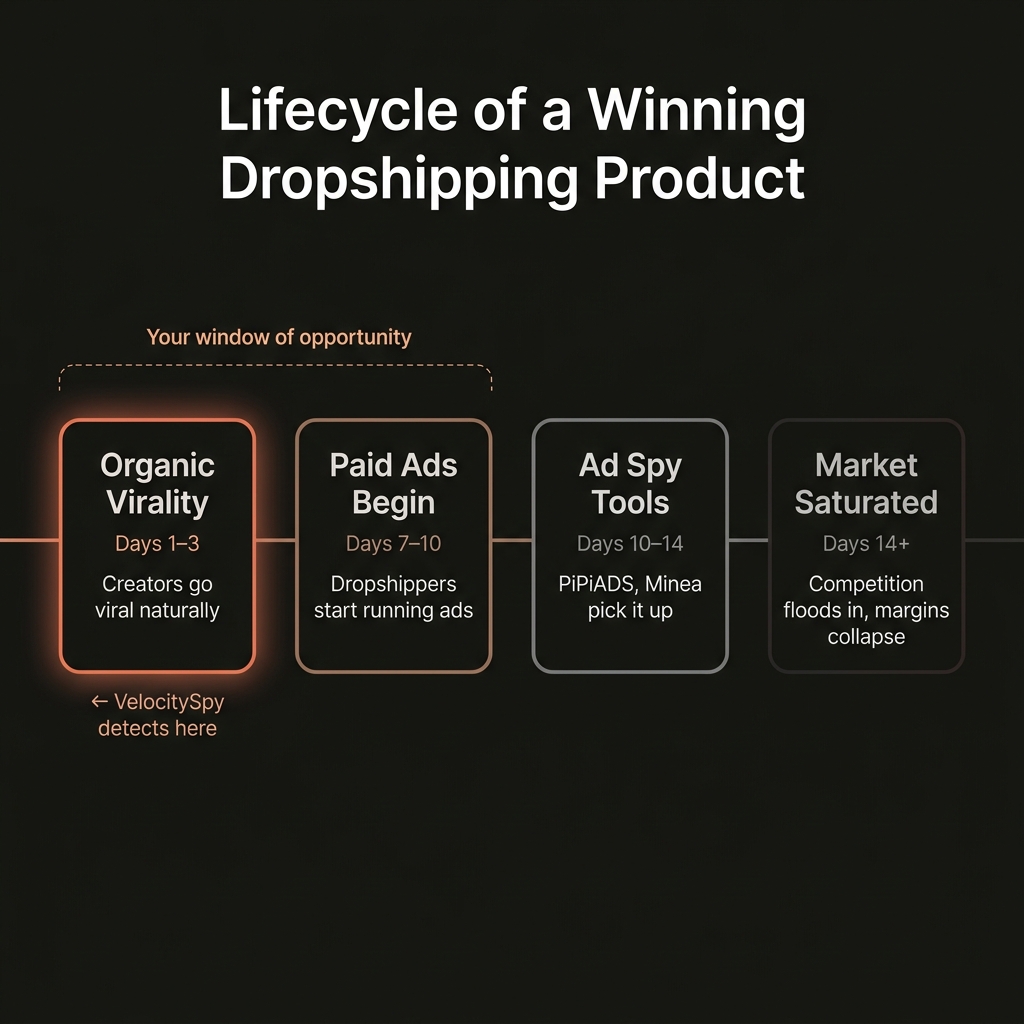
The lifecycle of a winning product follows a predictable pattern. A creator posts an organic TikTok video featuring some product, and it starts picking up views naturally — not because of ads, but because people actually like what they see. Over the next few days, more creators notice the same product trending and make their own videos about it. Organic views accelerate.
Then somewhere around day 7 to 14, the dropshippers who were paying attention start running paid ads. The product appears in ad spy tools like PiPiADS and Minea. A week later, every product research tool on the market is showing this product. The market floods with sellers, margins compress, and the opportunity window closes.
Traditional ad spy tools enter this story at the paid ads stage — sometimes even later. That’s already too late for most sellers. The real window of opportunity is the first 3 to 7 days, when organic creators are going viral with a product naturally, and nobody’s competing yet.
The question is: how do you monitor thousands of organic TikTok videos and identify which ones are gaining explosive momentum right now?
What Is Velocity — and Why It Matters More Than View Count
There’s a concept that will change how you think about product research, and it’s surprisingly simple.
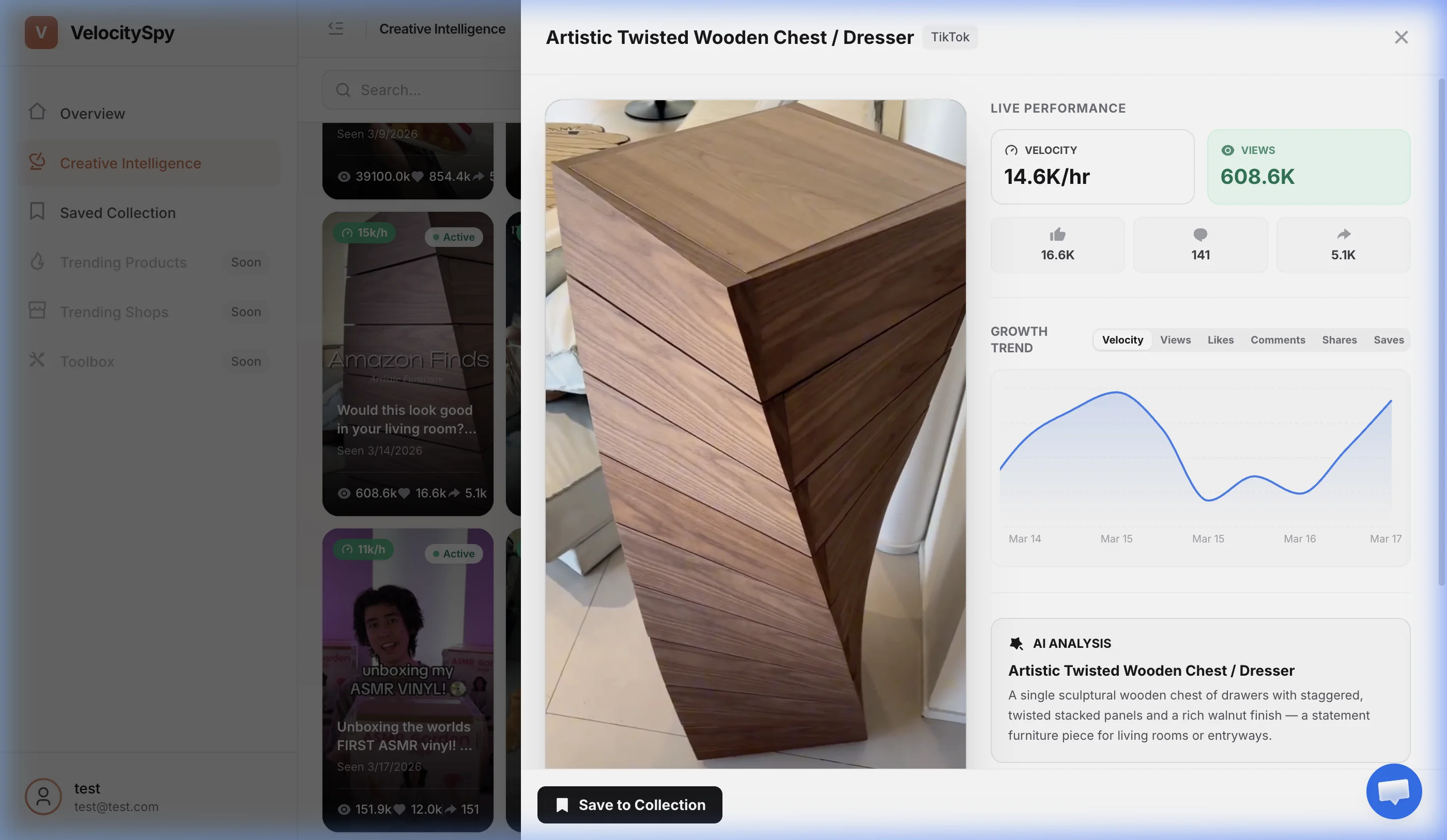
Velocity is views per hour. Not total views. Not lifetime impressions. How fast a video’s views are growing right now, in this moment.
Think about it this way. A video with 2 million views sounds impressive. But if it got those views over 6 months, it’s ancient history — that product’s cycle is long over. Meanwhile, a video with just 50,000 views that’s gaining 5,000 views per hour? That’s a product in the middle of an explosion. That’s the kind of momentum you can actually ride.
Total views tell you how popular something was. Velocity tells you how popular something is becoming. And when you combine high velocity with low total views, you’ve found a product in its very earliest breakout stage — before almost anyone else knows about it.
But here’s where it gets really powerful. When 3, 5, or 10 different creators are all going viral with the same product organically — and you can see that through velocity data — that’s not luck. That’s genuine, validated consumer demand. Multiple independent people making content about the same product and all getting strong engagement is the strongest signal you can get that a product is a real winner.

The 5-Step Process to Find Products Before Everyone Else
Step 1: Monitor Organic TikTok Videos, Not the Ad Library
This is the fundamental shift. Ad libraries show you what people are paying to promote. Organic TikTok shows you what’s going viral naturally. The second signal is more valuable because it appears earlier — before anyone starts running ads — and it proves real consumer interest. People watch and share organic content because they genuinely care about the product, not because an algorithm served them an ad.
Practically, this means you need to track thousands of TikTok e-commerce videos across different niches and measure how their views change hour by hour. You can do this manually by scrolling TikTok for hours every day, or you can use a tool that does it automatically. We built VelocitySpy for exactly this purpose — it tracks organic videos across dozens of niches 24/7 and calculates real-time velocity for each one.
Step 2: Sort by Velocity, Not Views
Once you’re tracking organic videos, the instinct is to sort by total views or likes. Resist that instinct. Sort by velocity instead.
Anything above 10,000 views per hour is explosive and worth acting on immediately. Between 1,000 and 10,000 views per hour signals strong momentum worth investigating. The 100 to 1,000 range means steady growth that’s worth keeping an eye on. Below 100 views per hour usually means the content is either too early to tell or already declining.
But raw velocity alone doesn’t tell the whole story. A single viral video could be a fluke — one creator with a massive following gets lucky with a particular post. That doesn’t necessarily mean the product is a winner. Which brings us to the most important step.
Step 3: Look for Multi-Creator Validation
A winning product isn’t validated by one video going viral. It’s validated by multiple independent creators going viral with the same product. When three or more unrelated creators all make videos about the same item and they all get strong velocity numbers, that’s real consumer demand — not just one person’s lucky post.
Two creators making similar content is interesting enough to investigate further. Three to five means the demand is probably real. More than five and you’re looking at a product that’s either going to be massive or is already on the edge of saturation — you’ll need to check timing carefully.
One important thing to watch for: make sure the creators are actually independent. If all five videos come from accounts that link to the same Shopify store, or if the usernames follow a suspiciously similar pattern, it’s probably one brand running multiple accounts. That’s marketing, not organic demand validation.
Step 4: Validate the Supply Side
You’ve found a product with high velocity and multiple independent creators. Before you go all in, spend 30 minutes checking the supply side.
Search for the product on AliExpress, CJ Dropshipping, or 1688. You want to confirm that it’s actually available for dropshipping, that the unit cost leaves you with a healthy margin — aim for at least 3x markup — that there are multiple suppliers so you’re not dependent on one factory, and that shipping times to the US are under 15 days.
Then check Amazon. If Amazon already has the product listed at $12 and you’d need to sell it for $25 to make margin, your customers will find the Amazon listing first. It’s usually not worth competing with that.
Finally, Google the product name along with words like “shop” or “store.” If 20 Shopify stores are already selling it, the window has probably closed. If you see zero to three stores, you’ve got an opening.
Step 5: Move Fast — You Have a 48 to 72 Hour Window
When you identify a product that passes the first four steps, speed matters more than perfection. The typical window between “organic momentum starts” and “market gets saturated” is roughly 2 to 5 days for hot products. Sometimes even less.
In the first couple of hours, source the product and line up suppliers. By hour six, have your product page set up — it doesn’t need to be perfect, it needs to exist. By hour twelve, film your own TikTok about the product. Within the first day, launch a paid ad using TikTok Spark Ads to boost your organic post. Then monitor, scale what works, and cut what doesn’t.
I’ve seen sellers miss products because they spent three days perfecting their store. By the time they launched, the product was already showing up in everyone’s PiPiADS feed. A decent store that launches today beats a perfect store that launches next week.
The takeaway here is simple. VelocitySpy shows you products at step 1 — when organic creators first start going viral. Ad spy tools show you the same products at step 5 — after paid ads are already running. That timing difference is the entire competitive advantage. See it in action →
Organic Velocity vs. Ad Library Tools: They’re Complementary
I want to be straightforward about something — ad spy tools aren’t useless. They serve a different purpose, and the smartest sellers use both.
| Factor | Organic Velocity Tracking | Ad Library Tools |
|---|---|---|
| When you see products | Days 1–3 of a trend | Days 7–14 (after ads start running) |
| What it tells you | Consumer demand exists organically | Someone is investing money in ads |
| Best for | Finding products before saturation | Analyzing ad creative and hooks |
| Risk | Product might not convert as paid ad | Product might already be saturated |
| Examples | VelocitySpy | PiPiADS, Minea, BigSpy |
The ideal workflow starts with organic velocity to spot products early — that’s your competitive advantage, your head start. Then you use ad spy tools to study what ad creatives and hooks work for similar products so you can craft better campaigns. If you could only pick one, organic velocity gives you the earlier signal. But if you can run both, you get the full picture.
How to Tell If a Product Is Already Saturated
One of the most common mistakes is jumping on a product that looks like it’s trending but has actually peaked. The product shows up on your radar with impressive numbers, you get excited, you launch — and then sales are disappointing because 50 other sellers launched the same week.
Here’s how to read the signals. A product is probably too late if more than 10 different sellers are already running ads for it in the ad library, if it appears in “trending products” lists across multiple spy tools at the same time, if Amazon has 20+ listings with reviews, if velocity has been declining for several days, or if multiple YouTube “winning product” channels have already featured it.
A product still has room if organic velocity is actively accelerating — meaning views per hour is going up, not down. Fewer than five sellers running ads is a good sign. No Amazon listings, or only one or two with minimal reviews, means the market hasn’t been flooded yet. If the product was first detected within the last week and most TikTok videos come from genuine creators rather than branded accounts, you’re likely early enough.
The key number to focus on is velocity trend direction. A product doing 10,000 views per hour but declining is a worse bet than one doing 2,000 views per hour and climbing. You want to ride the wave up, not catch it on the way down.
Which Niches Work Best for TikTok Dropshipping
Not every niche converts well through TikTok. Based on velocity data across thousands of products, certain categories consistently outperform others.
Home and garden products — cleaning tools, kitchen gadgets, organization systems — tend to generate some of the highest velocities. These products are inherently visual, easy to demonstrate in a short video, and sit in a price range that encourages impulse purchases. Gadgets and tech is another strong category, particularly phone accessories, portable tech, and LED products. Car accessories have been surprisingly strong, especially interior decor and phone mounts that look dramatic on camera.
Health and wellness products and beauty tools also perform well, though you need to be careful about compliance issues and platform restrictions with certain health claims.
The common thread across all these niches is that the products are visual — they look impressive on camera. They’re priced between $20 and $60, which sits in impulse buy territory. They solve an obvious problem or create an obvious “wow” reaction. And they can be demonstrated convincingly in 15 seconds or less.
Niches to approach more cautiously include clothing (high return rates and sizing headaches), supplements (compliance issues and frequent platform bans), and any commodity product priced under $10 where your margins evaporate after ad spend.
Common Mistakes That Kill Your Product Research
Waiting for certainty. There’s no such thing as being 100% sure a product will work before you launch. By the time you reach that confidence level, so has everyone else. The best sellers act on strong signals, not perfect data.
Ignoring velocity direction. This one is subtle but deadly. A product at 50,000 views per hour sounds incredible until you realize it was at 100,000 yesterday. That’s a declining trend. Meanwhile, a product at 2,000 views per hour that was at 500 yesterday is on an upward trajectory. Always check where the number is heading, not just where it is right now.
Copying ad creative from spy tools. If you’re using the same exact ad that 30 other sellers pulled from PiPiADS, you’re competing purely on price — which is a race to the bottom. Study the organic TikTok videos for creative inspiration instead. See what hooks and angles genuine creators are using, and build your own version.
Checking trends once a week. Products can explode and saturate within 5 days. A weekly research session means you’re structurally late to every opportunity. You need to be monitoring velocity daily — ideally getting real-time data so you can move the moment something breaks out.
What to Do Next
You now have the complete framework. Monitor organic videos instead of the ad library. Sort by velocity, not views. Validate demand by looking for multiple independent creators going viral with the same product. Check the supply side. And when everything lines up, move fast — because the window between discovery and saturation is measured in days, not weeks.
The hardest part isn’t the strategy. It’s having the data infrastructure to track velocity across thousands of videos in real time. That’s the piece that separates manual TikTok scrolling — which doesn’t scale — from systematic product discovery.
If you want to skip building spreadsheets and start seeing velocity data today, give VelocitySpy a try. Start your free 3-day trial — cancel anytime.